How to Say No After You’ve Already Said Yes: 10 Polite Ways
You’ve agreed to something. Perhaps you promised to help a friend move house, accepted an invitation to an event or volunteered for an extra project at work.
At the time, saying yes seemed like the easiest option.
Now you’re regretting it.
Maybe you’ve realised you don’t have enough time. Perhaps you agreed because you felt put on the spot. Or maybe you’ve simply changed your mind.
Whatever the reason, you’re now facing an awkward question:
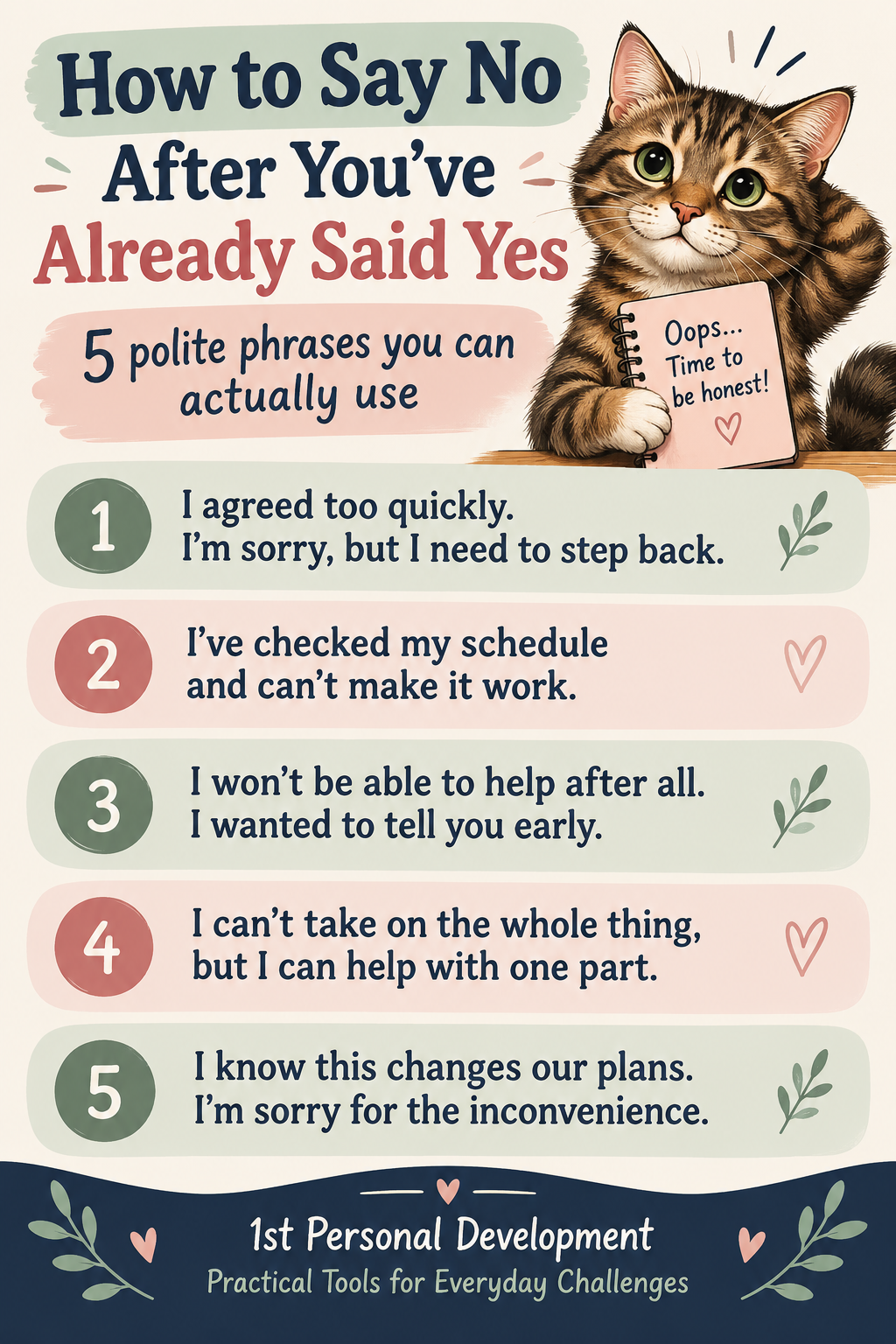
How do you say no when you’ve already said yes?
The good news is that you can change your mind. The trick is knowing what to say, when to say it and how to handle the other person’s reaction.
Here are 10 practical ways to approach the situation, including ready-to-use phrases you can adapt to your circumstances.
Sometimes the simplest explanation is also the most effective.
If you agreed without properly considering your availability, acknowledge it.
Try saying:
“I’m sorry, I agreed too quickly without thinking it through. I’ve realised I won’t be able to do it after all.”
This approach works particularly well when someone has asked you for a favour or invited you to an event.
You’re taking responsibility for your original answer without inventing an elaborate excuse.
You don’t necessarily need to explain every detail of why you’ve changed your mind.
2. Explain That Your Circumstances Have Changed
Sometimes you genuinely intended to honour a commitment, but something has changed.
Perhaps another responsibility has appeared, your workload has increased or you’ve discovered a scheduling conflict.
Try saying:
“When I agreed, I thought I’d have enough time. Unfortunately, my circumstances have changed, and I won’t be able to make it work.”
Keep your explanation straightforward.
Avoid inventing circumstances that don’t exist. A simple, truthful explanation is generally easier to manage than an excuse you’ll have to remember later.
3. Tell Them as Soon as Possible
This is particularly important when someone is relying on you.
Imagine agreeing to look after a friend’s dog while they’re away, then deciding you can’t do it.
Telling them immediately gives them an opportunity to make alternative arrangements.
Waiting until the last minute could create a much bigger problem.
Try saying:
“I wanted to let you know as soon as possible that I won’t be able to help as planned. I’m sorry for the change, and I hope telling you now gives you time to arrange something else.”
The earlier you communicate, the more considerate your decision is likely to feel.
4. Offer a Smaller Commitment
Sometimes you don’t want to withdraw completely. You’ve simply realised you’ve agreed to more than you can reasonably manage.
In that situation, consider whether there’s a smaller contribution you’re genuinely happy to make.
Try saying:
“I’ve realised I can’t take on the whole project, but I could help with the first part if that would still be useful.”
Or:
“I won’t be able to spend the whole day helping, but I could spare an hour in the morning.”
Only offer an alternative if you genuinely have the time and want to do it.
Otherwise, you risk replacing one unwanted commitment with another.
5. Acknowledge the Inconvenience
Changing your mind isn’t always consequence-free.
Someone might have made plans based on your original agreement. They may feel disappointed, frustrated or inconvenienced.
Acknowledging that can help you communicate respectfully.
Try saying:
“I understand this may cause you some inconvenience, and I’m sorry about that. Unfortunately, I won’t be able to go ahead with what we arranged.”
Notice that you’re acknowledging the impact of your decision without promising something you can’t deliver.
You can be considerate and still maintain your decision.
6. How to Back Out of Plans With Friends Politely
Social invitations can be particularly awkward.
Perhaps you accepted an invitation because you didn’t want to disappoint someone. Now you’re facing an evening you’d rather not attend.
Before cancelling, consider whether your friend has already spent money or made arrangements specifically for you.
If it’s a casual invitation, a short message may be enough.
Try saying:
“Thanks so much for inviting me. I’m sorry, but I’ve realised I won’t be able to come after all. I hope you have a lovely time.”
If you’d genuinely like to see the person another time, you could add:
“Would you fancy meeting for coffee next week instead?”
However, don’t suggest alternative plans simply because you feel guilty.
It’s perfectly reasonable to decline an invitation without immediately creating another obligation.
7. How to Say No After Agreeing to Extra Work
Work commitments require a slightly different approach.
If you’ve agreed to an additional task, withdrawing without discussing the consequences could create problems for colleagues or your employer.
Rather than simply announcing that you won’t do the work, explain the competing priorities and discuss what’s realistic.
Try saying:
“When I agreed to take this on, I underestimated the time involved. I’m concerned I won’t be able to complete everything to the required standard. Could we review the priorities and decide what needs to be done first?”
Alternatively:
“I can complete this additional task, but it would mean delaying my existing project. Which would you prefer me to prioritise?”
These approaches are especially useful when the underlying problem is workload rather than an unwillingness to help.
They also encourage a practical conversation about expectations.
8. What to Say When Someone Makes You Feel Guilty
This is often the hardest part.
You’ve finally found the courage to change your mind, only for the other person to respond with disappointment.
They might say:
“But you promised!”
“I was counting on you!”
“You’re letting me down!”
First, consider whether their frustration is reasonable. If they’ve made important arrangements based on your agreement, you may need to help address the consequences.
However, acknowledging their disappointment doesn’t automatically mean you must reverse your decision.
Try saying:
“I understand why you’re disappointed. I’m sorry I agreed before properly thinking it through, but I still won’t be able to do it.”
If the conversation becomes repetitive:
“I understand this isn’t the answer you wanted. Unfortunately, my decision hasn’t changed.”
Avoid getting drawn into an endless cycle of explanations.
Sometimes a calm, consistent response communicates your position more effectively than offering increasingly complicated justifications.
9. What If You’ve Left It Until the Last Minute?
Ideally, you’d communicate your change of plans immediately.
But what if you’ve been putting off the conversation and the commitment is now approaching?
The answer depends on the situation.
Cancelling a casual coffee date is very different from withdrawing from an arrangement involving money, travel or someone’s safety.
Consider whether you can reasonably fulfil your original commitment. If you genuinely cannot, communicate immediately and take responsibility for any avoidable inconvenience.
Try saying:
“I’m sorry I’ve left this so late. I should have spoken to you sooner. I won’t be able to do what we arranged, and I understand this creates a problem. Can we discuss what would help you make alternative arrangements?”
If you’ve entered into a formal agreement or contractual obligation, check its terms before assuming you can simply withdraw.
The goal is to deal with the situation responsibly rather than allowing embarrassment to make it worse.
10. How to Avoid Saying Yes Too Quickly Next Time
The easiest commitment to withdraw from is one you never made in the first place.
If you regularly find yourself agreeing to things you later regret, try building a short pause into your responses.
You don’t need to give an immediate answer simply because someone has asked a question.
Here are five phrases worth practising:
“Let me check my diary and get back to you.”
“Can I have a little time to think about it?”
“I’m not sure I can commit to that just yet.”
“I need to check what else I’ve got on.”
“Thanks for asking. I’ll let you know tomorrow.”
These phrases give you time to consider whether you actually want to agree and whether you can realistically fulfil the commitment.
Remember to follow up when you’ve promised to give someone an answer.
Over time, this simple habit can help you avoid many awkward conversations.
Three Questions to Ask Before Changing Your Mind
Before withdrawing from a commitment, consider these three questions:
1. Why do I want to withdraw?
Have your circumstances genuinely changed? Did you agree without thinking? Or are you simply experiencing temporary reluctance about something you still want to do?
Understanding your reason will help you decide how to approach the conversation.
2. How much is the other person relying on me?
A casual social invitation is different from a commitment involving significant expense, essential care or professional responsibilities.
Consider the practical consequences and whether you have obligations that need to be addressed.
3. What’s the most considerate way to communicate my decision?
Would a short message be appropriate, or does the situation deserve a telephone call or face-to-face conversation?
Think about what you need to communicate and whether offering practical assistance would be appropriate.
These questions aren’t designed to make you feel guilty. They’re simply a way to balance your own needs with consideration for other people.
Need Help Finding the Right Words?
Knowing that you’re allowed to change your mind is one thing. Finding the words to explain your decision can be quite another.
If you regularly struggle with saying no, setting boundaries or declining requests, having a few prepared phrases can make those conversations easier to approach.
Our Say No Without Feeling Guilty Kit includes 50 ready-to-use phrases and printable worksheets designed for everyday situations.
Whether you’re dealing with requests from friends, family or colleagues, you’ll have practical examples you can adapt rather than starting from scratch.
 How do you say no when you’ve already said yes?