Feeling Overwhelmed by Everything You Need to Do? 10 Small Steps That Help
Ever looked at your to-do list and wondered where on earth you’re supposed to start?
Perhaps the house needs tidying, emails are piling up, there are bills to deal with, and you’ve got half a dozen unfinished jobs competing for your attention.
You know you need to do something.
But instead of getting started, you find yourself staring at the list, making another cup of tea or scrolling through your phone.
Sound familiar?
When everything feels urgent, even deciding what to do first can become difficult.
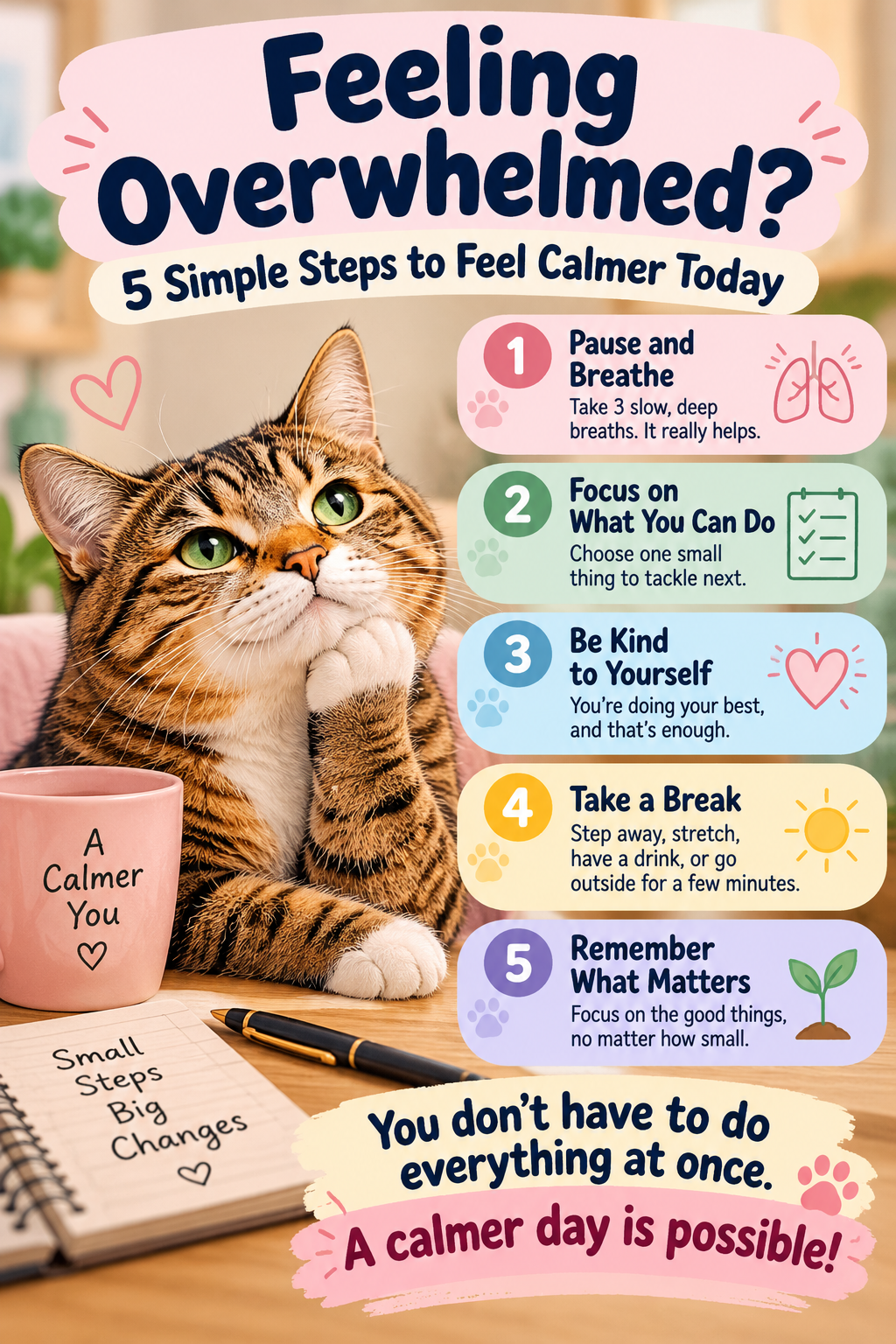
The good news is that you don’t have to sort out your entire life today.
Sometimes the best way forward is to make things smaller, simpler and more manageable.
Here are ten practical steps to try when you’re feeling overwhelmed by everything you need to do.
When you’ve got twenty things on your mind, it’s tempting to tackle several at the same time.
You start replying to an email, remember you need to pay a bill, open another browser tab, notice the washing needs doing and suddenly you’re doing five things without finishing any of them.
Instead, pause for a moment.
Ask yourself:
“What’s one useful thing I could do next?”
Not the most impressive thing.
Not the thing that will magically fix everything.
Just one useful action.
It might be replying to an important message, clearing the kitchen table or booking an appointment.
One completed task is a better starting point than five half-finished ones.
2. Get Everything Out of Your Head
Trying to remember every unfinished job is exhausting.
A simple brain dump can help you see what you’re dealing with.
Take a notebook or open a blank document and write down everything that’s competing for your attention.
Include the big things and the little things.
For example:
Pay electricity bill.
Reply to Sarah.
Sort paperwork.
Book car service.
Tidy spare room.
Finish website update.
Buy birthday card.
Don’t worry about organising the list yet.
The first goal is simply to get everything onto paper.
Once you can see the tasks in front of you, they’re often easier to sort into a sensible order.
3. Separate Urgent Tasks From Everything Else
One reason a long to-do list feels overwhelming is that every task appears equally important.
But it isn’t.
Some things genuinely need attention today.
Others can wait until next week.
And a few might not need doing at all.
Try dividing your list into three categories:
Must do soon: Tasks with real deadlines or consequences.
Can do later: Useful jobs that aren’t immediately urgent.
Optional: Things you’d like to do but don’t actually need to prioritise.
For example, paying a bill that’s due tomorrow probably belongs in the first category.
Reorganising your bookshelf probably doesn’t.
This simple exercise can make a long list feel considerably less intimidating.
4. Choose Just Three Priorities for Today
If your daily to-do list contains 25 items, you’re setting yourself a difficult challenge before you’ve even started.
Instead, try choosing three realistic priorities.
For example:
Pay the electricity bill.
Reply to two important emails.
Spend 15 minutes sorting paperwork.
That’s your main list for the day.
Anything else you complete is a bonus.
You can still keep a separate master list of everything that needs doing, but your daily focus should be manageable.
A short list you can complete is often more useful than an ambitious list you constantly abandon.
5. Make the First Step Ridiculously Small
Sometimes a task feels overwhelming because you’re thinking about the entire project rather than the first action.
“Sort out my finances” sounds enormous.
“Find my latest bank statement” sounds manageable.
“Declutter the house” could take days.
“Clear one drawer” might take ten minutes.
“Build a website” is a major project.
“Write down three possible page headings” is a small starting point.
Try asking:
“What’s the smallest action that would count as progress?”
Make it so simple that getting started doesn’t require a major effort.
You can always do more once you’ve begun.
6. Use a Ten-Minute Timer
When a job feels unpleasant or complicated, try committing to just ten minutes.
Set a timer and work on one task until it rings.
Then decide whether to continue or take a break.
This can work particularly well for:
Sorting paperwork.
Tidying a room.
Answering emails.
Organising digital files.
Starting a project you’ve been avoiding.
You’re not promising to finish the entire task.
You’re simply agreeing to make ten minutes of progress.
And sometimes that’s enough to get things moving.
7. Give Yourself Permission to Take a Break
When you’re busy, taking a break can feel like wasting time.
But constantly pushing yourself isn’t always the most productive approach.
If you’ve been sitting at a desk for hours, step away for a few minutes.
Make a drink.
Stretch.
Go outside for some fresh air.
Or simply sit somewhere quiet without looking at another screen.
A short break can give you a chance to return to your tasks with a clearer sense of what to do next.
The important thing is to make the break intentional, rather than accidentally spending an hour scrolling through your phone.
8. Stop Adding Unnecessary Tasks
Sometimes our to-do lists become overwhelming because we keep agreeing to things we don’t really have time for.
A friend asks for a favour.
A colleague wants help with something.
Someone invites you to an event.
You say yes automatically, then wonder how you’re going to fit everything in.
Before accepting another commitment, try asking yourself:
“Do I genuinely have the time and energy for this?”
If the answer is no, it’s perfectly reasonable to decline politely.
For example:
“Thanks for thinking of me, but I can’t take anything else on this week.”
Or:
“I’d love to help, but I need to finish a few things first.”
Protecting your time is an important part of managing your existing responsibilities.
9. Make Tomorrow Easier Before Today Ends
You don’t need an elaborate evening routine.
Just spend five minutes preparing for tomorrow.
You might:
Write down your three priorities.
Put important paperwork somewhere visible.
Clear your desk.
Prepare something you’ll need in the morning.
Decide which task you’ll start first.
The goal is to reduce the number of decisions waiting for you tomorrow.
Imagine sitting down in the morning and already knowing what your first task is.
That’s much easier than starting the day by trying to organise everything from scratch.
10. Notice What You’ve Actually Accomplished
It’s surprisingly easy to finish a busy day feeling as though you’ve achieved nothing.
That’s often because you’re concentrating on everything that remains unfinished.
Try keeping a short “done list” alongside your to-do list.
Write down the tasks you’ve completed, however small.
Perhaps you made an awkward phone call.
Paid a bill.
Cleared your inbox.
Took the first step on a project.
Those things count.
Progress doesn’t always look dramatic.
Sometimes it’s simply having fewer unfinished jobs than you had yesterday.
A Simple 15-Minute Reset for Overwhelming Days
If you’re not sure where to begin, try this quick exercise.
Minutes 1–3: Write everything down.
Get your tasks and worries about unfinished jobs onto paper.
Minutes 4–6: Identify what’s genuinely urgent.
Circle anything with an immediate deadline or important consequence.
Minutes 7–9: Choose one manageable task.
Pick something useful that you can begin straight away.
Minutes 10–15: Take action.
Spend five minutes working on that task.
You don’t have to finish it.
You just have to start.
By the end of fifteen minutes, you’ll have a clearer list, a sensible priority and at least a little progress.
That’s a worthwhile beginning.
What If You’re Still Feeling Overwhelmed?
Some days are simply more demanding than others.
You might have too many commitments, unexpected problems or circumstances that aren’t entirely within your control.
In those situations, a better to-do list won’t solve everything.
It may be necessary to postpone non-essential tasks, ask someone for practical help or reconsider commitments that are no longer manageable.
Remember that being productive isn’t the same as being busy every minute of the day.
And you don’t need to judge yourself by how much you manage to squeeze into 24 hours.
Final Thoughts: Small Steps Still Count
When everything feels overwhelming, it’s easy to believe you need a dramatic fresh start.
A completely new routine.
A perfectly organised home.
A detailed plan for every area of your life.
But you don’t need to change everything at once.
Start by writing things down.
Choose what’s important.
Make the next task smaller.
And give yourself credit for the progress you make.
You don’t have to get everything done today. You just need a sensible place to start.
Want a More Structured Fresh Start?
If you’d like a practical framework for getting organised and finding some direction, our Get Your Life Back on Track Kit provides a printable 72-hour reset plan.
The 34-page PDF includes guided exercises, planning worksheets and simple actions to help you review where you are, decide what matters and begin moving forward.
It’s designed for anyone who wants a more structured way to make a fresh start without trying to change everything overnight.
 When you’ve got twenty things on your mind, it’s tempting to tackle several at the same time.