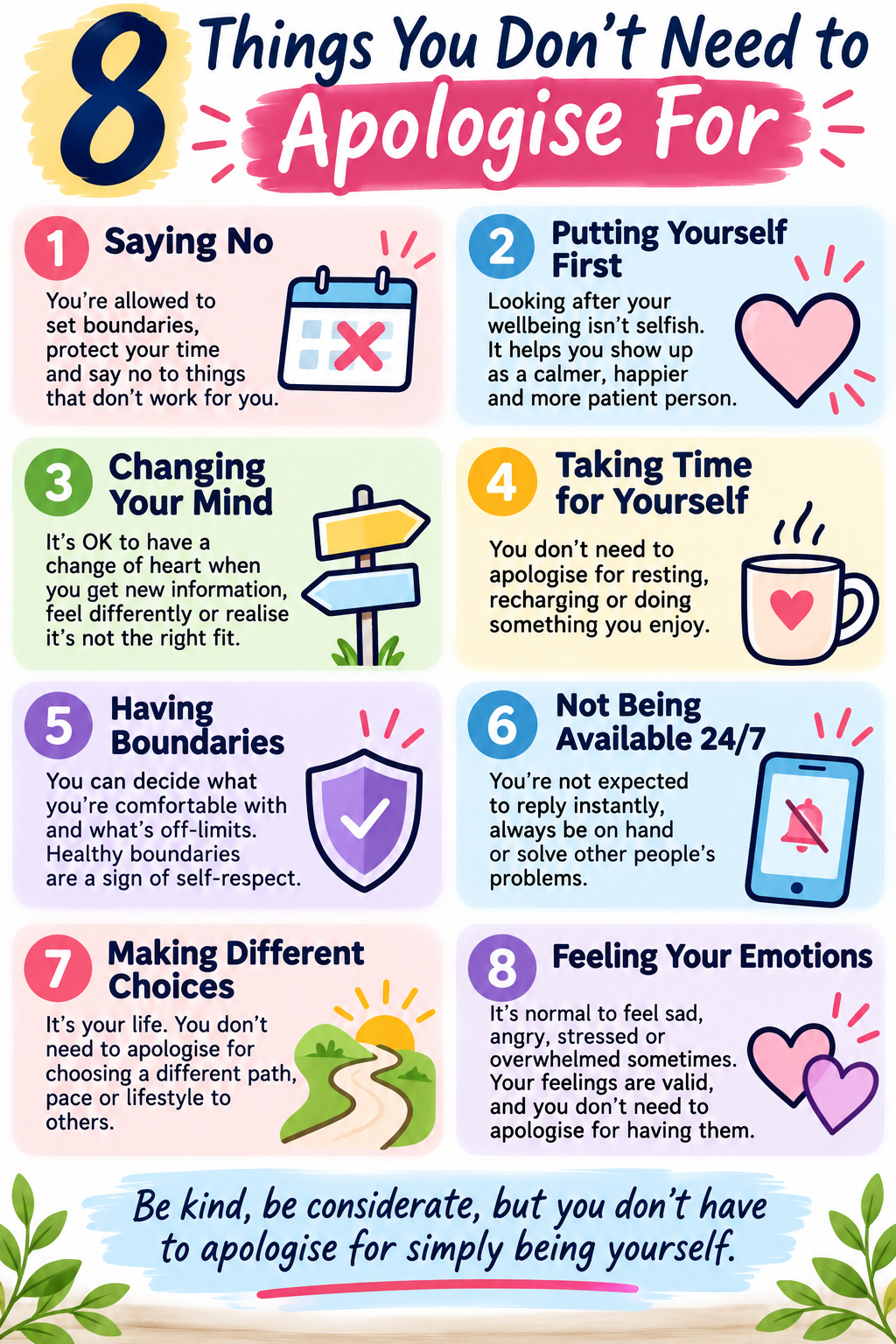
8 Things You Don’t Need to Apologise For (And How to Stop Feeling Guilty)
Do you ever find yourself saying “sorry” when you haven’t actually done anything wrong?
Perhaps you apologise for turning down an invitation, taking too long to reply to a message, or asking someone to respect your boundaries.
Sometimes the word slips out almost automatically.
Being considerate of other people’s feelings is a good thing. But constantly apologising for your needs, preferences and decisions can leave you feeling as though you’re always doing something wrong.
The truth is, you can be kind and thoughtful without apologising for simply being yourself.
Here are eight things you don’t need to apologise for, along with some practical ways to express yourself confidently and politely.
There’s a difference between being selfish and recognising that your own needs matter.
You might need an evening to yourself, a break from responsibilities or time to focus on something important to you.
That doesn’t mean you care any less about other people.
In fact, constantly ignoring your own needs can leave you exhausted, resentful and less able to give your best to the people around you.
Instead of saying:
“I’m really sorry, I know I should be doing more for everyone.”
Try:
“I need to make some time for myself this week.”
You don’t have to earn the right to look after yourself by reaching the point of exhaustion first.
3. Changing Your Mind
Have you ever agreed to something and later realised it wasn’t right for you?
Perhaps you accepted an invitation, volunteered for a project or made a decision before you had all the information.
Changing your mind isn’t necessarily a sign of unreliability. Sometimes it’s the sensible response to new circumstances.
Of course, if you’ve made a commitment that affects someone else, it’s important to communicate promptly and take responsibility for any genuine inconvenience.
But you don’t need to apologise for having different priorities or opinions as you learn and grow.
Instead of saying:
“I’m so sorry, I’m terrible at making decisions.”
Try:
“Having thought about it some more, I’ve decided to take a different approach.”
Or:
“My circumstances have changed, so I need to reconsider.”
Changing your mind thoughtfully is very different from letting people down carelessly.
4. Taking Time for Yourself
Rest isn’t something you should have to apologise for.
You don’t need to fill every spare hour with work, chores, favours or social commitments.
Sometimes you simply want to read, go for a walk, enjoy a hobby or spend a quiet evening doing very little.
And that’s perfectly reasonable.
Instead of saying:
“Sorry, I know I’m being lazy, but I just want to stay home.”
Try:
“I’m having a quiet evening tonight.”
Or:
“I’ve set aside some time to recharge.”
You don’t need an impressive excuse for taking a break.
5. Having Personal Boundaries
Boundaries help define what you’re comfortable with and how you want to be treated.
They might involve your time, personal space, privacy, finances or the way someone speaks to you.
For example, you might prefer not to discuss your income with relatives, answer work messages late at night or lend money to friends.
You can communicate those limits without being unkind.
Instead of saying:
“I’m really sorry, I know it’s silly, but I don’t like talking about that.”
Try:
“I’d rather keep that private.”
Or:
“I’m not comfortable discussing that.”
Or:
“I’d appreciate it if you didn’t bring that up again.”
Remember that setting a boundary isn’t about controlling someone else’s behaviour. It’s about explaining what you will or won’t participate in.
6. Not Being Available 24/7
Modern technology makes it easy for people to contact us at almost any time.
But having a phone doesn’t mean you’re obliged to answer every call, text or message immediately.
You might be working, resting, spending time with family or simply enjoying some uninterrupted peace.
Unless you’ve agreed to be available for something urgent, it’s reasonable to respond when you can.
Instead of saying:
“I’m so sorry! I’m terrible! I can’t believe I didn’t reply straight away!”
Try:
“Thanks for your message. I’ve only just had a chance to respond.”
Or:
“I wasn’t available earlier. What did you need?”
A delayed reply isn’t automatically something you’ve done wrong.
7. Making Different Choices From Other People
Not everyone wants the same kind of life.
Some people love busy social calendars. Others prefer quieter routines.
Some prioritise career progression, while others value flexibility, family time or creative interests.
You might choose a different lifestyle, relationship, career or set of goals from the people around you.
And that’s fine.
You can respect someone else’s choices without feeling obliged to make the same ones.
Instead of saying:
“Sorry, I know it’s probably strange, but I don’t want that.”
Try:
“That’s not really what I’m looking for.”
Or:
“I’m happy with the direction I’ve chosen.”
You don’t need everyone to understand or approve of your decisions.
8. Having Feelings
Feeling disappointed, angry, anxious, sad or overwhelmed doesn’t make you a bad person.
Emotions are part of being human.
You don’t need to apologise simply because you’re upset or because something matters to you.
What matters is how you express those feelings and how you treat other people.
For example, feeling angry is understandable. Speaking cruelly to someone because you’re angry may still require an apology.
Instead of saying:
“Sorry, I’m being ridiculous for getting upset.”
Try:
“I’m feeling upset about what happened, and I’d like a little time to process it.”
Or:
“That situation was difficult for me.”
You can acknowledge your emotions without dismissing them or blaming yourself for having them.
When Should You Actually Apologise?
None of this means you should stop apologising altogether.
A genuine apology is valuable when you’ve made a mistake, broken an agreement, treated someone unfairly or caused avoidable harm.
The difference is between apologising for something you’ve done and apologising simply for having needs or preferences.
Before automatically saying sorry, ask yourself:
Have I actually done something wrong?
Have I hurt someone or broken a reasonable commitment?
Am I apologising because I feel guilty, or because an apology is genuinely appropriate?
Could I express appreciation or explain my decision instead?
For example, rather than saying “Sorry for taking up your time” when someone has willingly helped you, try “Thank you for taking the time to help me.”
That small change can make your communication feel more positive and confident.
How to Stop Apologising So Much
If saying sorry has become a habit, you don’t need to change overnight.
Start by noticing the situations where you apologise unnecessarily.
Perhaps it’s when you ask a question, decline a request, disagree with someone or need a little time for yourself.
Then practise replacing automatic apologies with clearer language.
Here are a few examples:
Instead of saying
Try saying
“Sorry to bother you.”
“Do you have a moment?”
“Sorry, I can’t come.”
“Thanks for inviting me, but I can’t make it.”
“Sorry for having an opinion.”
“I see it differently.”
“Sorry, I need some space.”
“I need a little time to myself.”
“Sorry for the late reply.”
“Thanks for your patience.”
The aim isn’t to eliminate the word “sorry” from your vocabulary.
It’s to use it when you genuinely mean it, rather than as an automatic response to every uncomfortable situation.
Need Help Saying No Without Feeling Guilty?
Sometimes knowing that you don’t need to apologise is the easy part.
Finding the right words when someone puts you on the spot can be much harder.
If you struggle with saying no, handling pressure or explaining your boundaries, my Say No Without Feeling Guilty (Even When It’s Hard) Kit offers practical scripts and worksheets to help you respond more confidently.
It includes 25 ready-to-use refusal scripts, guilt-free response templates and simple assertiveness exercises.
 Saying no can feel surprisingly difficult, particularly when someone is asking for a favour or expecting you to agree.