How to Back Out of Plans Politely: 12 Messages That Work
We’ve all been there.
You agree to dinner with friends, accept an invitation to a party or promise to attend a family gathering.
At the time, it sounds like a good idea.
But as the date approaches, you realise you’d rather not go. Perhaps you’re exhausted, you’ve taken on too much or something else has come up.
Now you’re wondering how to back out of plans politely without upsetting anyone.
The awkward part isn’t necessarily deciding to cancel. It’s figuring out exactly what to say.
Fortunately, cancelling plans doesn’t have to involve elaborate excuses or lengthy explanations.
Here are 12 ready-to-use messages for different situations, along with practical advice on handling disappointment and avoiding unnecessary misunderstandings.
People’s circumstances change, and sometimes commitments become difficult or impossible to keep.
However, there’s an important difference between cancelling a casual coffee date and backing out of something another person has spent considerable time or money arranging.
Before cancelling, consider three things:
How much notice can you give?
Is someone relying on you?
Will cancelling cause significant inconvenience or expense?
Being considerate doesn’t mean you must accept every invitation or attend every event.
It means recognising that your decisions sometimes affect other people.
Whenever possible, communicate early, be honest and take responsibility for any inconvenience.
12 Polite Messages for Cancelling Plans
The following examples are designed to be adapted to your circumstances.
Choose the one that best reflects your situation rather than sending a message that doesn’t accurately explain your decision.
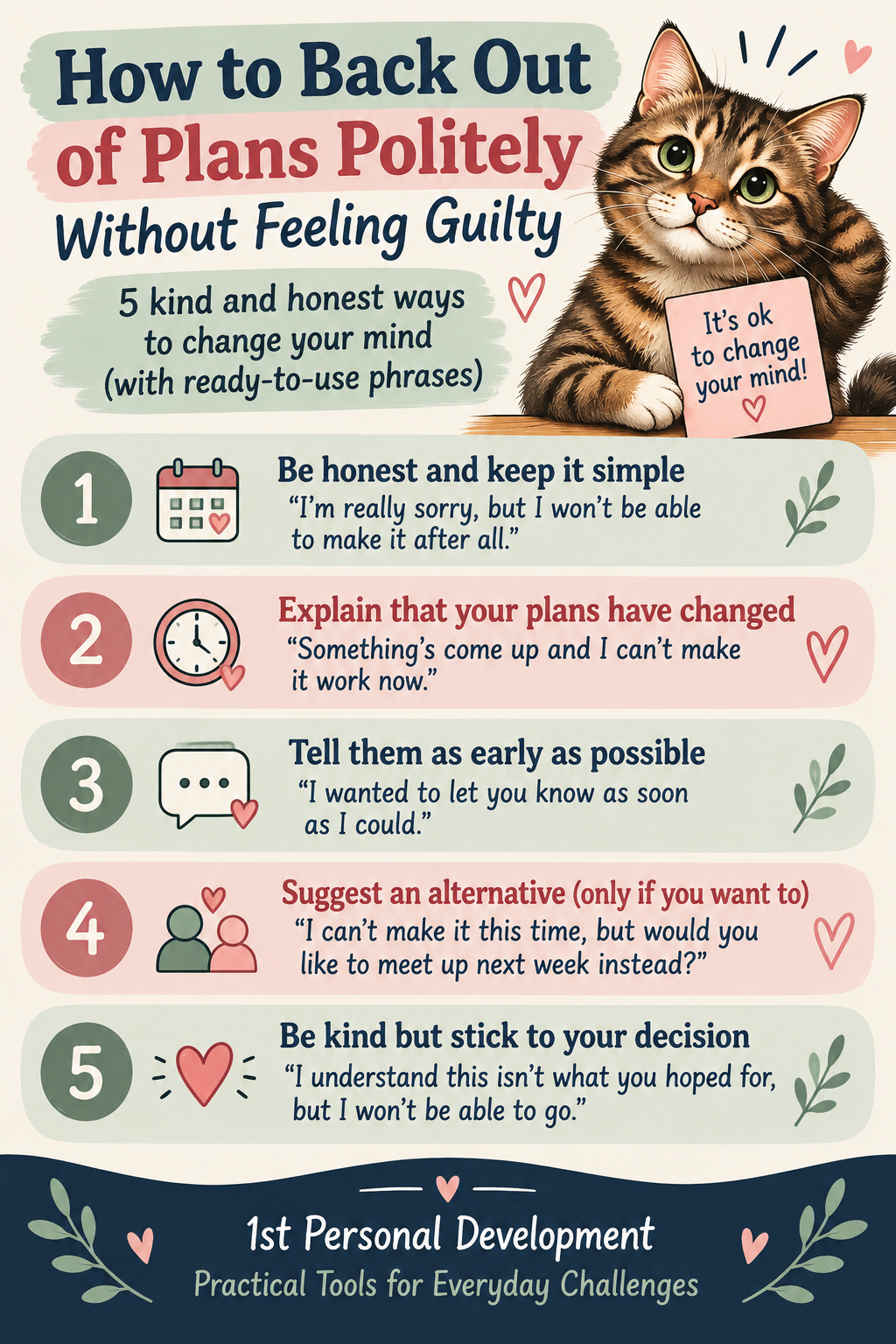
1. When You Simply Can’t Make It
Sometimes a straightforward explanation is all you need.
Message:
“I’m really sorry, but I won’t be able to make it after all. I wanted to let you know as soon as possible. I hope you have a lovely time!”
This works particularly well for casual social invitations where the other person hasn’t made significant arrangements specifically for you.
You don’t need to provide a detailed explanation unless you want to.
2. When You’ve Taken On Too Much
Perhaps you’ve agreed to several commitments and your diary is now looking rather frightening.
Message:
“I’ve realised I’ve taken on a bit too much this week, and I need to cancel our plans. I’m sorry for changing things after we’d arranged to meet.”
This is a useful alternative to inventing an emergency.
It also acknowledges that you made the original commitment.
3. When You Need Some Time to Yourself
Sometimes you simply need an evening without social commitments.
You don’t necessarily need to pretend you’re ill or manufacture an elaborate excuse.
Message:
“I’m sorry, but I’ve had a particularly busy week and need a quiet evening at home. I won’t be able to make it tonight. I hope you understand.”
Of course, cancelling repeatedly for this reason may affect your relationships.
If it’s becoming a regular occurrence, consider agreeing to fewer plans in the first place.
4. When You’d Genuinely Like to Rearrange
If you still want to see someone but the original arrangement no longer works, suggesting another date can demonstrate that you value the relationship.
Message:
“I’m really sorry, but I need to cancel our plans for Saturday. Would you be free next Wednesday instead? I’d still love to catch up.”
Only suggest an alternative if you genuinely intend to follow through.
Otherwise, you could find yourself repeating the same uncomfortable conversation next week.
5. When You Don’t Want to Rearrange
Here’s a situation that can feel particularly awkward.
You want to cancel, but you don’t want to immediately commit to another date.
That’s perfectly reasonable.
Message:
“Thanks so much for inviting me. I’m sorry I can’t make it this time, but I really appreciate you thinking of me.”
Notice that there’s no promise to rearrange.
You can appreciate an invitation without automatically creating another obligation.
6. When You’ve Agreed to a Group Event
Cancelling group arrangements can sometimes be easier because the event may go ahead without you.
However, check whether your absence affects bookings, shared costs or transport.
Message:
“Hi everyone! I’m sorry, but I won’t be able to join you on Saturday after all. I wanted to give you plenty of notice. Have a brilliant time!”
If you’ve agreed to contribute towards a booking, discuss any costs you’re responsible for.
7. When You’ve Already Cancelled Once
Cancelling repeatedly can understandably frustrate people.
If you’ve already rearranged an event, acknowledge that rather than pretending the previous cancellation never happened.
Message:
“I’m really sorry to do this again. I know we’ve already rearranged once, and I understand if you’re frustrated. Unfortunately, I won’t be able to make it this weekend.”
If you’re unsure when you’ll realistically be available, avoid proposing another date immediately.
It may be better to wait until you can make a commitment you’re confident about keeping.
If someone has already travelled, paid for tickets or made significant arrangements, your decision may have real consequences.
Message:
“I’m very sorry for the short notice. I know we had everything arranged, but I won’t be able to make it. I understand this is inconvenient, and I apologise for leaving it so late.”
Where appropriate, offer to cover costs you’ve caused or help find a practical alternative.
If the arrangement involves a formal booking, check its cancellation terms.
9. When Someone Has Organised Something Special
Perhaps a friend has arranged a birthday meal, family celebration or special outing.
In these situations, a personal message or telephone call may be more considerate than a brief text.
Message:
“Thank you so much for organising everything. I really appreciate the effort you’ve put in. Unfortunately, I won’t be able to attend, and I’m genuinely sorry to miss it.”
If appropriate, you might send a card or arrange to celebrate separately.
The important thing is to acknowledge the effort involved.
10. When You Need to Cancel a Work-Related Social Event
Work-related social arrangements can involve different expectations from ordinary social invitations.
If attendance is genuinely optional, a polite message may be sufficient.
Message:
“Thank you for organising the event. Unfortunately, I won’t be able to attend this time, but I appreciate the invitation. I hope everyone has a great evening.”
If attendance is part of your professional responsibilities, discuss the situation with the appropriate person rather than assuming you can simply withdraw.
11. When You Don’t Want to Explain Your Reason
You may have personal circumstances that you’d rather keep private.
You can communicate your decision without disclosing everything.
Message:
“I’m sorry, but something personal has come up and I won’t be able to make it. I appreciate your understanding.”
Only use this wording when it’s truthful.
You don’t need to invent a personal emergency simply because you’re uncomfortable saying no.
Sometimes “I’m sorry, but I won’t be able to attend” is enough.
12. When Someone Won’t Accept Your Cancellation
Occasionally, the most difficult part of cancelling plans is dealing with the response.
Someone may repeatedly ask why, suggest alternatives or pressure you to reconsider.
If you’ve considered your obligations and genuinely cannot attend, you may need to repeat your decision calmly.
Message:
“I understand you’re disappointed, and I’m sorry our plans have changed. Unfortunately, I still won’t be able to make it.”
If necessary, you can add:
“I appreciate you trying to find another solution, but I won’t be available.”
You can acknowledge someone’s disappointment without entering an endless negotiation.
How to Cancel Plans Without Making Excuses
When we’re uncomfortable disappointing someone, it’s tempting to invent a convincing explanation.
Unfortunately, complicated excuses can create additional problems.
You may need to remember what you said, answer follow-up questions or explain why your circumstances suddenly changed.
A straightforward message is usually easier.
Try following this simple formula:
1. Acknowledge the arrangement.
“I’m sorry, but I need to cancel our plans for Friday.”
2. Give a brief, truthful explanation if appropriate.
“I’ve realised I’ve taken on too much this week.”
3. Recognise any inconvenience.
“I know we’d already arranged everything, and I’m sorry for changing things.”
4. Offer an alternative only if you genuinely want to.
“Would you like to meet next week instead?”
You don’t necessarily need all four elements every time.
For a casual invitation, one or two sentences may be sufficient.
Should You Cancel by Text or Telephone?
It depends on the circumstances.
A quick text may be perfectly appropriate for an informal coffee date or casual group gathering.
However, a telephone call or personal conversation may be more considerate when:
Someone has made significant arrangements for you.
Your cancellation could cause considerable inconvenience.
You’re withdrawing from an important commitment.
The situation is particularly sensitive.
Consider how you’d prefer someone to communicate with you if the roles were reversed.
Also remember that a message isn’t particularly helpful if the recipient doesn’t see it until after they’ve left home.
Make sure your cancellation actually reaches them.
What If Someone Gets Upset When You Cancel?
Even when you’ve communicated politely, someone may still be disappointed.
That’s understandable.
They may have been looking forward to seeing you or rearranged their own commitments to accommodate your plans.
Backing out of plans can feel uncomfortable, particularly when you dislike disappointing people.
But you don’t need an elaborate excuse or a lengthy explanation every time your circumstances change.
The most useful approach is usually straightforward: communicate early, be honest, acknowledge any inconvenience and offer alternatives when appropriate.
And remember that being considerate works both ways.
Respect other people’s time and arrangements, but give yourself time to think before agreeing to commitments you may struggle to keep.
 People’s circumstances change, and sometimes commitments become difficult or impossible to keep.