Feeling overwhelmed by everything? Discover 10 simple ways to calm your thoughts, regain perspective and feel more in control when life gets too much.
Have you ever had one of those days when everything seems to be happening at once?
Your phone keeps ringing. There’s too much to do. Someone needs something from you. You’re worrying about tomorrow while still trying to deal with yesterday.
And somewhere in the middle of it all, your brain decides to remind you of seventeen other things you haven’t done.
Suddenly, even the smallest task feels enormous.
When you’re overwhelmed, the natural temptation is to try to solve everything immediately.
But sometimes the most useful thing you can do is stop trying to fix everything for a moment and give your mind a chance to settle.
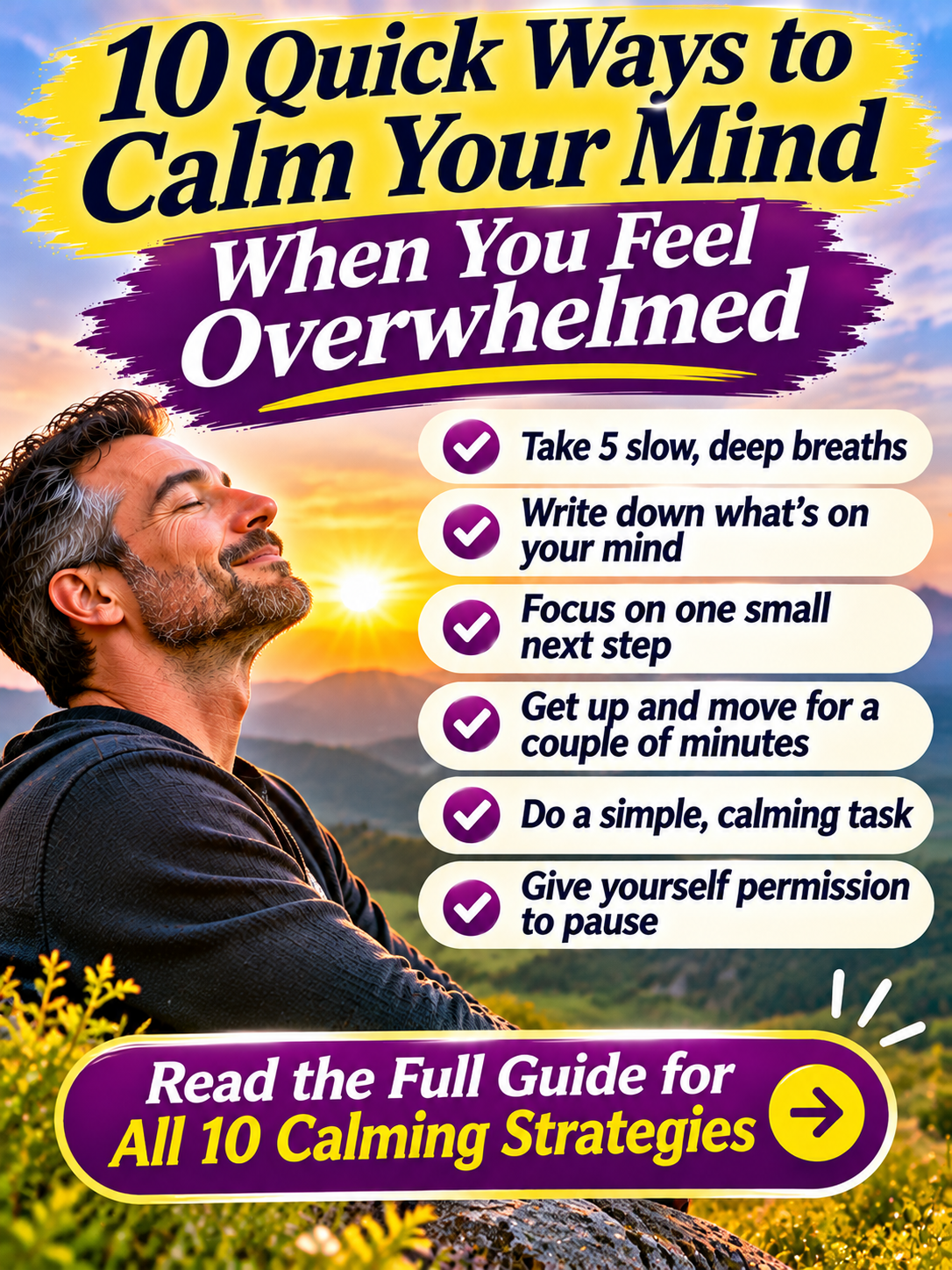
Here are ten simple strategies you can try.
1. Take Five Slow, Comfortable Breaths
When everything feels urgent, your breathing may become quicker and shallower without you noticing.
Taking a few slower breaths can help you pause and redirect your attention.
Try this:
- Sit comfortably and relax your shoulders.
- Breathe in gently through your nose.
- Exhale slowly without forcing your breath.
- Repeat five times at a comfortable pace.
You don’t need to count perfectly or follow a complicated technique.
The aim is simply to create a brief moment of calm.
Try this today: Before responding to the next stressful demand, take five comfortable breaths and give yourself a few seconds to think.
2. Write Down What’s on Your Mind
One reason overwhelm feels so exhausting is that you’re trying to remember, organise and worry about everything simultaneously.
Your mind becomes a rather unreliable filing cabinet.
Writing things down can help.
Grab a notebook or open a blank document and write everything that’s bothering you.
Don’t worry about putting things in the right order.
Include tasks, worries, appointments, decisions and anything else demanding your attention.
Once everything is on paper, you can begin separating genuine priorities from things that can wait.
Try this today: Spend five minutes doing a complete brain dump. You don’t need to solve anything yet.
3. Focus on One Small Next Step
Overwhelm often comes from looking at everything you need to do rather than identifying what you can do next.
Perhaps you have twenty unfinished tasks.
Thinking about all twenty at once can make it difficult to start any of them.
Instead, ask yourself:
“What’s one useful thing I could do in the next ten minutes?”
It might be replying to one email, making one phone call, clearing a small space or writing the first paragraph of something you’ve been postponing.
You don’t need to complete the entire project.
You simply need a manageable starting point.
Try this today: Choose one small action and give it your attention for ten minutes.
4. Get Up and Move for a Couple of Minutes
When your thoughts are racing, a small change in physical activity can help interrupt the cycle.
Stand up.
Stretch gently.
Walk around the room.
Step outside for some fresh air.
You don’t need a demanding workout.
Even a brief change of position or surroundings can give you an opportunity to reset your attention.
If you’re able to take a short walk somewhere pleasant, so much the better.
Try this today: When you notice yourself getting overwhelmed, take a two-minute movement break before returning to what you were doing.
5. Do a Simple, Calming Task
Sometimes the best way to regain a sense of control is to do something small and familiar.
Make a cup of tea.
Water a plant.
Fold a few clothes.
Tidy your desk.
Wash a handful of dishes.
Choose something that doesn’t require complicated decisions or intense concentration.
The purpose isn’t to distract yourself from every responsibility.
It’s to give your attention a brief rest from the constant stream of competing demands.
Try this today: Pick one simple activity that you find soothing and spend five minutes doing it without multitasking.
6. Give Yourself Permission to Pause
One of the most difficult things about feeling overwhelmed is the belief that you shouldn’t stop.
There’s too much to do.
People are waiting.
You’re already behind.
Surely taking a break will only make things worse?
Not necessarily.
When you’re mentally overloaded, pushing yourself harder can make it more difficult to concentrate or decide what matters.
A short pause may help you return with a clearer perspective.
And remember, rest doesn’t have to be earned by completing every task on your list.
Try this today: Take a short break without using it to worry about everything you should be doing.
7. Separate What’s Urgent From What Can Wait
When you’re overwhelmed, everything can start to feel equally important.
But usually it isn’t.
Some things genuinely need attention today.
Others would be nice to finish.
And some can safely wait until next week.
Try dividing your tasks into three categories:
Must do today: Things with genuine consequences if delayed.
Can do later: Important tasks that don’t require immediate attention.
Can let go: Tasks that aren’t necessary, can be simplified or don’t need doing at all.
Be realistic rather than ambitious.
A shorter, achievable list is often more helpful than a beautifully organised list of fifty impossible demands.
Try this today: Identify your three most important priorities and allow the rest to wait where possible.
8. Reduce the Noise Around You
Sometimes overwhelm isn’t caused by one enormous problem.
It’s caused by dozens of small interruptions.
Notifications.
Messages.
Background television.
Social media.
Multiple browser tabs.
People asking questions while you’re trying to concentrate.
If possible, reduce some of that noise.
Put your phone on silent for a short period.
Close unnecessary tabs.
Move somewhere quieter.
Turn off background distractions.
You may not be able to control your entire environment, but even one small adjustment can make concentrating easier.
Try this today: Give yourself fifteen minutes without unnecessary notifications or interruptions.
9. Stop Trying to Solve Tomorrow’s Problems Today
Overthinking and overwhelm often go hand in hand.
You start with something that needs attention now.
Then you think about what might happen tomorrow.
Then next week.
Then six months from now.
Before long, you’re mentally dealing with problems that haven’t happened and may never happen.
Planning ahead is useful.
But repeatedly imagining every possible difficulty can leave you exhausted without making you better prepared.
Ask yourself:
“Does this need a decision now, or can I deal with it when I have more information?”
If it doesn’t require immediate attention, consider writing it down and returning to it at a suitable time.
Try this today: Choose one future worry that doesn’t need action today and give yourself permission to leave it for now.
10. Remind Yourself That You Don’t Have to Do Everything at Once
When life feels overwhelming, it’s easy to believe that you need to get everything under control immediately.
But you don’t.
You can deal with one problem at a time.
You can ask for help.
You can change your plans.
You can decide that something isn’t as important as you originally thought.
And you can make progress without doing everything perfectly.
Try reminding yourself:
“I don’t have to sort out my whole life today. I just need to decide what matters next.”
Sometimes that small change in perspective is enough to make the day feel more manageable.
A Simple Five-Minute Reset for Overwhelming Moments
If you don’t know where to begin, try this short routine.
Minute 1 — Pause and breathe
Sit comfortably and take a few slow, natural breaths.
Minute 2 — Empty your mind
Write down the thoughts and tasks demanding your attention.
Minute 3 — Identify what matters
Choose the one thing that genuinely needs attention first.
Minute 4 — Reduce distractions
Put aside anything that doesn’t help with that priority.
Minute 5 — Begin
Take one small, practical step.
You don’t need to feel completely calm before you start.
The aim is simply to make the situation feel a little more manageable.
What If You Feel Overwhelmed All the Time?
Everyone experiences overwhelming periods occasionally.
But if you’re regularly struggling to cope, it’s worth considering whether something in your circumstances needs to change.
Perhaps you’re taking on too many responsibilities.
Maybe you’re not getting enough rest.
You might need additional support, clearer boundaries or a more realistic workload.
If persistent overwhelm is affecting your sleep, health or everyday life, consider speaking with a qualified healthcare professional.
There’s no requirement to manage everything alone.
More Help When Everything Feels Too Much
If overwhelm is making it difficult to organise your thoughts or decide what to do next, you might also enjoy these resources.
Feeling Overwhelmed by Everything You Need to Do? 10 Small Steps That Help
If the problem is an enormous to-do list, this article offers practical ways to break tasks down and regain momentum.
Read the 10 Small Steps article
Get Your Life Back on Track Kit — 72-Hour Reset
If you’d prefer a more structured approach, this digital toolkit provides a three-day reset plan, planning worksheets and small daily actions to help you regain a sense of direction.
Explore the 72-Hour Reset Kit on Etsy
Final Thoughts: Calm Comes Before Clarity
When everything feels overwhelming, you may instinctively try to think harder, work faster or solve more problems.
But sometimes what you really need is a little space.
A few comfortable breaths.
A short walk.
A piece of paper.
One manageable task.
You don’t have to transform your entire day in five minutes.
You simply need to find a way to make the next few minutes a little easier.
You don’t have to do everything right now. Start with one small thing, and let that be enough for the moment.
Related Posts: