Why Is It So Hard to Say No to Last-Minute Requests?
There are several reasons we find ourselves agreeing to things we’d rather not do.
We don’t want to seem selfish. We worry that saying no means we’re not a good friend, colleague or family member.
We feel put on the spot. A sudden request can make us answer before we’ve had time to think.
We want to avoid awkwardness. Saying yes feels easier than dealing with someone else’s disappointment.
We’re used to being helpful. If people regularly rely on us, refusing can feel uncomfortable.
But here’s something worth remembering:
Someone else’s urgency doesn’t automatically create an obligation for you.
You can care about people and still have limits on your time.
12 Polite Ways to Say No to Last-Minute Favours
These phrases work in different situations. Choose one that sounds natural to you rather than trying to memorise them all.
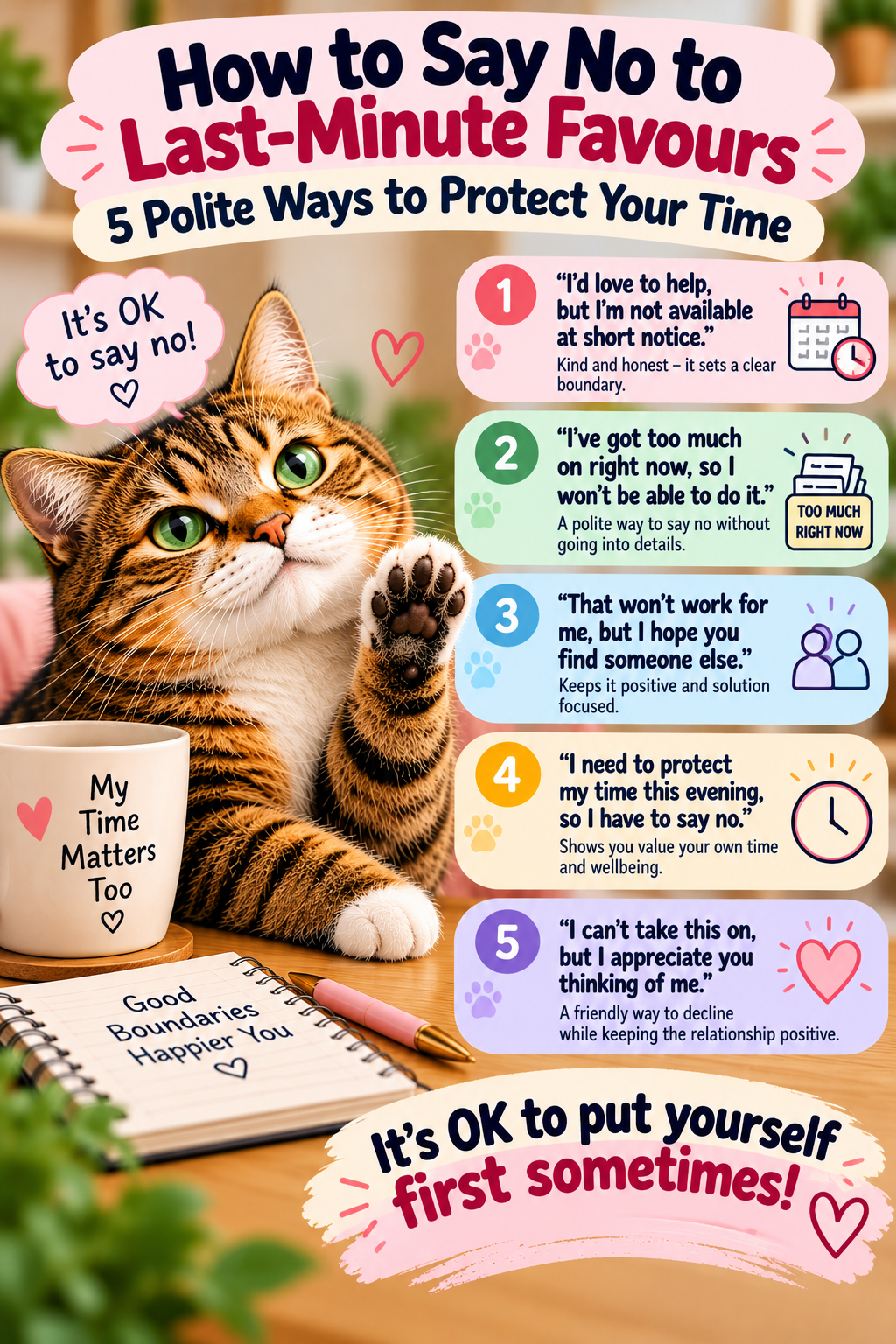
1. “I’d love to help, but I’m not available at such short notice.”
This is a friendly, straightforward response when someone springs a request on you.
It acknowledges their situation without committing you to anything.
Best for: Friends, family members and casual requests.
2. “I’ve got too much on right now, so I won’t be able to do it.”
Sometimes the simplest explanation is the best.
You don’t need to list everything on your schedule or prove that you’re busy enough to justify saying no.
Best for: Extra tasks, errands and requests when you’re already overloaded.
3. “That won’t work for me, but I hope you find someone else.”
This is useful when you want to be polite without explaining your reasons.
It’s short, clear and difficult to misunderstand.
Best for: Requests you don’t want to negotiate.
4. “I need to protect my time this evening, so I’ll have to say no.”
Your personal time matters, even when you haven’t planned anything particularly important.
Resting, reading, watching television or simply having a quiet evening are perfectly valid ways to spend your time.
Best for: Last-minute evening and weekend requests.
5. “I can’t take this on, but I appreciate you thinking of me.”
This phrase works especially well when someone asks because they trust your abilities.
You can appreciate their confidence without accepting another responsibility.
Best for: Work requests, volunteering and extra commitments.
6. “I’m sorry, I’ve already made plans.”
You don’t have to explain what those plans involve.
And remember, a planned quiet evening at home still counts as a plan.
Best for: Social requests, unexpected invitations and favours that would disrupt your day.
7. “I wish you’d asked me earlier. Unfortunately, I can’t help today.”
This gently highlights the short notice without sounding accusatory.
It also encourages the other person to give you more warning next time.
Best for: People who frequently leave requests until the last minute.
8. “I’m not able to help today, but I could look at it next week.”
Only use this if you genuinely want to help at another time.
Offering an alternative can be useful, but don’t feel obliged to make one.
Best for: Requests where timing is the main problem.
9. “I’m in the middle of something and can’t drop it right now.”
This is particularly helpful when someone assumes you can immediately stop whatever you’re doing.
It reminds them that your existing commitments deserve respect too.
Best for: Colleagues, neighbours and unexpected phone calls.
10. “I don’t want to promise something I can’t properly commit to.”
This is a thoughtful way of declining a request that would stretch you too thin.
It communicates that you’re being realistic rather than unhelpful.
Best for: Bigger favours, responsibilities and time-consuming tasks.
11. “I understand it’s urgent, but I’m not in a position to help.”
Sometimes people are genuinely dealing with a difficult situation.
You can acknowledge that without taking responsibility for solving it.
Best for: Requests involving pressure or urgency.
Of course, genuine emergencies involving someone’s immediate safety are different from ordinary last-minute favours.
12. “I’m going to have to say no this time.”
Simple. Polite. Final.
You don’t always need a detailed explanation.
In fact, the more reasons you give, the more opportunities someone has to argue with them.
Best for: Almost any situation where you want to be clear and firm.
How to Say No Without Feeling Guilty
Knowing what to say is one thing. Actually saying it can be another.
Here are a few ways to make it easier.
Give Yourself Permission to Think
You don’t have to answer immediately.
Try:
“Let me check what I’ve got on and get back to you.”
This gives you time to decide whether you genuinely want to help, rather than agreeing automatically.
Just make sure you do get back to them.
Keep Your Explanation Short
Long explanations can sometimes make a refusal sound negotiable.
Compare these two replies:
“I can’t tonight because I’ve had a really busy week, I’m tired, I’ve got some things to finish, and I was hoping to relax.”
And:
“Sorry, I’m not available tonight.”
Both are polite, but the second leaves less room for debate.
Don’t Invent an Excuse
It’s tempting to make up an appointment or pretend you’re busy.
But you don’t need a dramatic reason to decline an ordinary favour.
A simple, truthful response is usually easier to maintain.
Remember That Disappointment Isn’t the Same as Harm
Someone might be disappointed when you say no.
That’s understandable.
But disappointment doesn’t automatically mean you’ve done something wrong.
Healthy relationships allow people to have different needs and priorities.
What If Someone Keeps Pushing After You’ve Said No?
Some people accept a refusal immediately. Others keep asking.
If that happens, try repeating your answer calmly rather than offering increasingly elaborate explanations.
For example:
Them: “Are you sure? It would only take half an hour.”
You: “I understand, but I’m still not available.”
Them: “Couldn’t you just squeeze it in?”
You: “I’m afraid not. I hope you can find another solution.”
You don’t have to become angry or defensive.
Sometimes repeating the same calm answer is enough.
And if someone regularly ignores your boundaries, it may be worth having a separate conversation about expectations.
What If You’ve Already Said Yes?
Perhaps you agreed automatically and then realised you simply can’t manage it.
That happens too.
The best approach is usually to let the person know as soon as possible, acknowledge any inconvenience and avoid leaving them wondering.
For example:
“I’ve had another look at my schedule and I won’t be able to help tomorrow after all. I’m sorry for the change of plans, and I wanted to let you know straight away.”
The earlier you tell them, the more opportunity they have to make alternative arrangements.
How to Stop Becoming Everyone’s Last-Minute Solution
If you’re constantly receiving urgent requests, it might be time to change the expectations people have of you.
That doesn’t mean becoming unkind or refusing every request.
It simply means making your availability more realistic.
You might say:
“I don’t usually have much flexibility at short notice, so please ask me a few days ahead if you can.”
Or:
“I’m happy to help when I’ve got time, but I can’t always rearrange things at the last minute.”
Over time, consistent boundaries can help people understand that your time isn’t automatically available.
Final Thoughts: You Can Be Kind and Still Say No
Being helpful is a wonderful quality.
But being helpful shouldn’t mean sacrificing your own plans, energy or wellbeing every time someone asks for something.
You don’t need to apologise repeatedly, invent elaborate excuses or explain every detail of your day.
Sometimes a simple “I’m sorry, I can’t help this time” is all that’s needed.
Remember: being a good person doesn’t mean being available to everyone, all the time.
And the next time someone asks for a last-minute favour, you’ll have a few ready-to-use phrases to make saying no that little bit easier.
Want more practical ways to handle awkward requests and conversations? Explore our other articles on setting boundaries, saying no politely and communicating with confidence.
 There are several reasons we find ourselves agreeing to things we’d rather not do.