How to Overcome Decision Paralysis: 7 Practical Ways to Make a Choice
Have you ever spent half an hour comparing two products, only to buy neither?
Or researched a decision so thoroughly that you ended up more confused than when you started?
Perhaps you’ve made a list of pros and cons, asked three friends for advice, read dozens of reviews — and still couldn’t decide.
Welcome to decision paralysis.
The frustrating thing is that the more important a decision feels, the harder it can become to make one. But even relatively small choices can leave us going round in circles.
The good news? You don’t necessarily need more information. Sometimes you simply need a better way to make the decision.
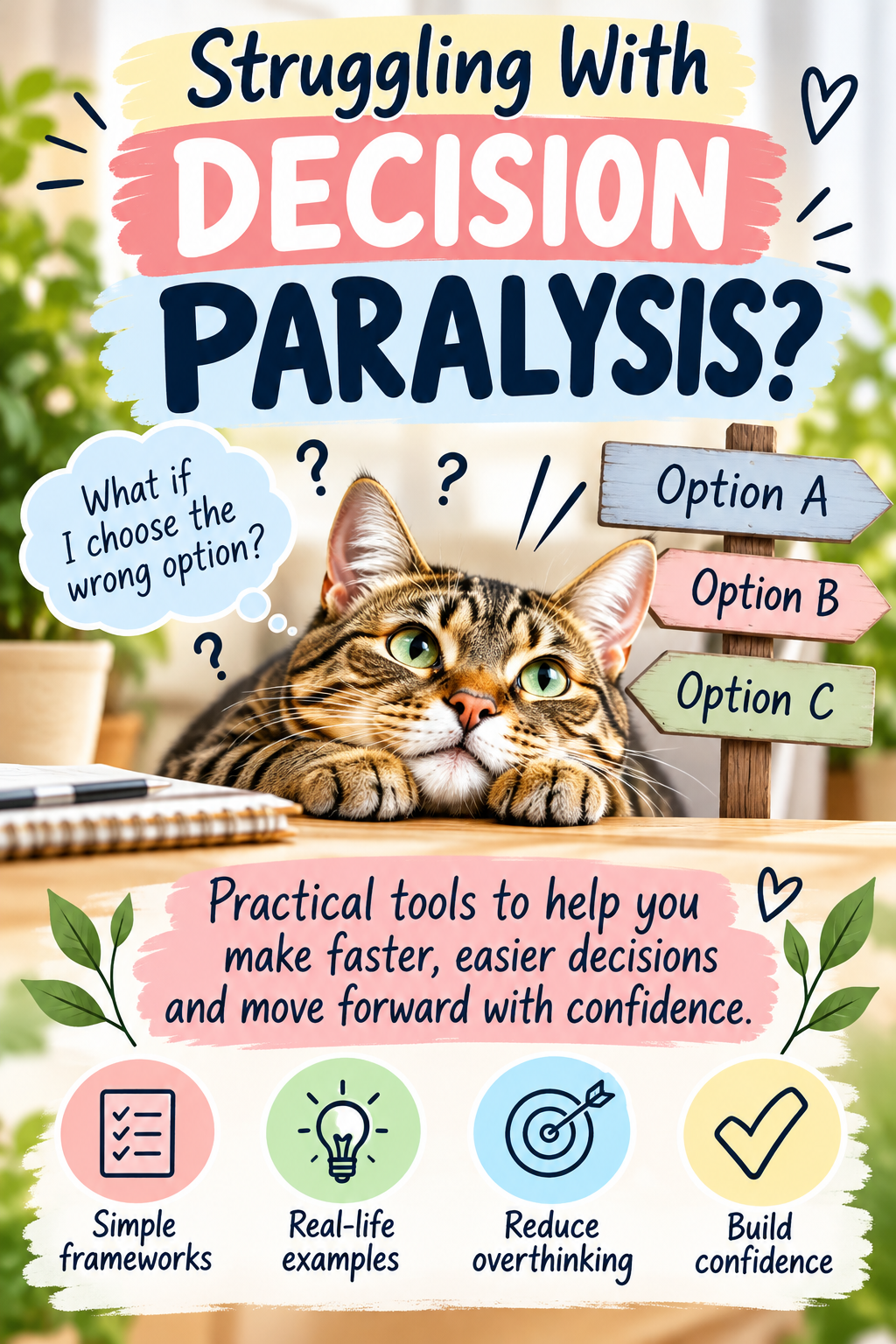
Decision paralysis, sometimes called analysis paralysis, happens when you spend so much time considering your options that making a choice becomes difficult.
It might look like:
Constantly comparing alternatives without reaching a conclusion.
Worrying that you’ll regret whichever option you choose.
Searching for more information even when you already know enough.
Asking other people for reassurance repeatedly.
Putting off a decision because none of the options feels perfect.
Being thoughtful isn’t a problem. The difficulty begins when thinking stops helping you move forward.
1. Use the Two-Minute Decision Rule
Not every decision deserves an afternoon of research.
For small, low-risk choices, try giving yourself just two minutes.
For example:
Which film should I watch tonight?
What should I cook for dinner?
Which notebook should I buy?
Which household task should I tackle first?
Set a timer, consider your options and make a choice before it runs out.
The purpose isn’t to make perfect decisions. It’s to avoid spending more time choosing than the decision is worth.
Try this: Ask yourself, “Will this decision still matter next month?”
If the answer is probably not, consider making it quickly.
Save your careful analysis for decisions that genuinely deserve it.
2. Narrow Your Options Down to Three
Imagine choosing a new laptop.
You start with five possibilities. Then you discover another twelve. Before long, you’ve got 27 browser tabs open and no idea which laptop you actually want.
Sound familiar?
Instead of comparing everything, create a shortlist of no more than three realistic options.
First, decide what matters most.
For a laptop, that might be:
A maximum budget of £600.
Good battery life.
A comfortable keyboard.
Remove anything that doesn’t meet those requirements.
Now compare your three remaining options rather than the entire internet.
Try this: Write down your three most important requirements before looking at any more alternatives.
This works for purchases, holiday destinations, projects and many everyday choices.
3. Replace the Perfect Choice With a Good-Enough Choice
One reason decisions become difficult is the belief that there must be one perfect answer.
The perfect holiday.
The perfect business idea.
The perfect time to start.
The perfect purchase.
But most real-world decisions involve compromises.
One option might be cheaper. Another might be more convenient. A third might offer better quality.
Instead of asking, “Which is absolutely the best?”, try asking:
“Which option meets my most important needs?”
Suppose you’re choosing a weekend break.
Your requirements are somewhere peaceful, within two hours of home and reasonably priced.
You find a destination that meets all three.
Do you really need to spend another four hours looking for somewhere that might be marginally better?
Sometimes good enough is genuinely good enough.
4. Give Your Research a Stopping Point
Research can be useful. Endless research often isn’t.
A simple technique is to decide in advance when you’ll stop gathering information.
For example:
“I’ll read five reviews, compare three options and make my choice by Friday.”
Or:
“I’ll spend 30 minutes researching this purchase, then decide.”
You can also use an information stopping rule:
“I’ll only continue researching if the new information could realistically change my decision.”
That’s an important distinction.
Finding out that a product has a serious reliability problem could change your choice.
Reading a twenty-seventh review that repeats what you already know probably won’t.
For important financial, legal, medical or otherwise high-stakes decisions, allow appropriate time and seek qualified advice where necessary.
The goal isn’t to rush. It’s to recognise when more research has stopped being useful.
5. Use a Simple Decision Scorecard
When two or three options seem equally attractive, a scorecard can help you compare them more clearly.
Let’s imagine you’re choosing between three online courses.
You care about price, practical content and how much time each course requires.
Score each option from 1 to 5, where 5 is best.
Criteria
Course A
Course B
Course C
Affordability
5
3
4
Practical content
3
5
4
Fits your schedule
4
4
3
Total
12
12
11
Courses A and B are tied.
Now ask which criterion matters most.
If practical content is your top priority, Course B may be the better choice. If keeping costs down matters most, Course A might win.
The scorecard doesn’t make the decision for you. It helps you see what you’re really comparing.
6. Ask Whether the Decision Is Reversible
Some decisions are relatively easy to change.
Others have lasting consequences.
Treating every decision as though it’s permanent can make even small choices feel enormous.
Ask yourself:
“If I choose this and it doesn’t work out, how difficult would it be to change direction?”
Trying a new hobby is usually reversible.
Testing a different daily routine is reversible.
Choosing which book to read next is certainly reversible.
Decisions involving major financial commitments, contracts or significant life changes deserve more care.
For reversible choices, you can often learn more by trying something than by continuing to analyse it.
For less reversible choices, take the time to understand the consequences.
The trick is to match the amount of thinking to the actual stakes.
7. Turn Your Decision Into One Small Action
Sometimes you finally make a decision — but nothing happens.
You decide to start exercising, but don’t choose an activity.
You decide to create a website, but don’t register a domain.
You decide to take a course, but don’t enrol.
A decision becomes more useful when it leads to action.
Once you’ve chosen, complete this sentence:
“The first thing I’ll do is ________, and I’ll do it by ________.”
For example:
“I’ve decided to start learning Spanish. I’ll find a beginner lesson and complete it by Wednesday evening.”
Or:
“I’ve decided to declutter the spare room. I’ll spend 15 minutes sorting the first drawer tomorrow.”
The first step doesn’t have to be impressive.
It just needs to be something you can actually do.
A Quick Exercise for Your Next Difficult Decision
The next time you’re stuck, grab a piece of paper and answer these six questions:
What exactly am I trying to decide?
What are my three most realistic options?
Which two or three things matter most?
What information do I genuinely still need?
When will I make the decision?
What’s the first action I’ll take afterwards?
You might be surprised how much clearer a decision becomes once it’s written down.
Final Thoughts: You Don’t Need to Get Every Decision Right
Decision paralysis often comes from wanting to avoid mistakes.
But no amount of research can guarantee that every choice will turn out exactly as expected.
Sometimes the most useful question isn’t “What if I choose wrongly?”
It’s:
“What’s a sensible next step based on what I know today?”
Start with small decisions. Practise narrowing your options. Give yourself reasonable deadlines.
And remember that making a considered choice is often more useful than endlessly searching for a perfect one.
Want a Little More Structure?
If you’d like ready-to-use worksheets rather than starting with a blank page, our Decision Paralysis Toolkit brings these techniques together in one printable PDF.
It includes seven practical decision-making tools, worked examples, reusable worksheets and a seven-day challenge to help you practise making choices.
 Decision paralysis, sometimes called analysis paralysis, happens when you spend so much time considering your options that making a choice becomes difficult.