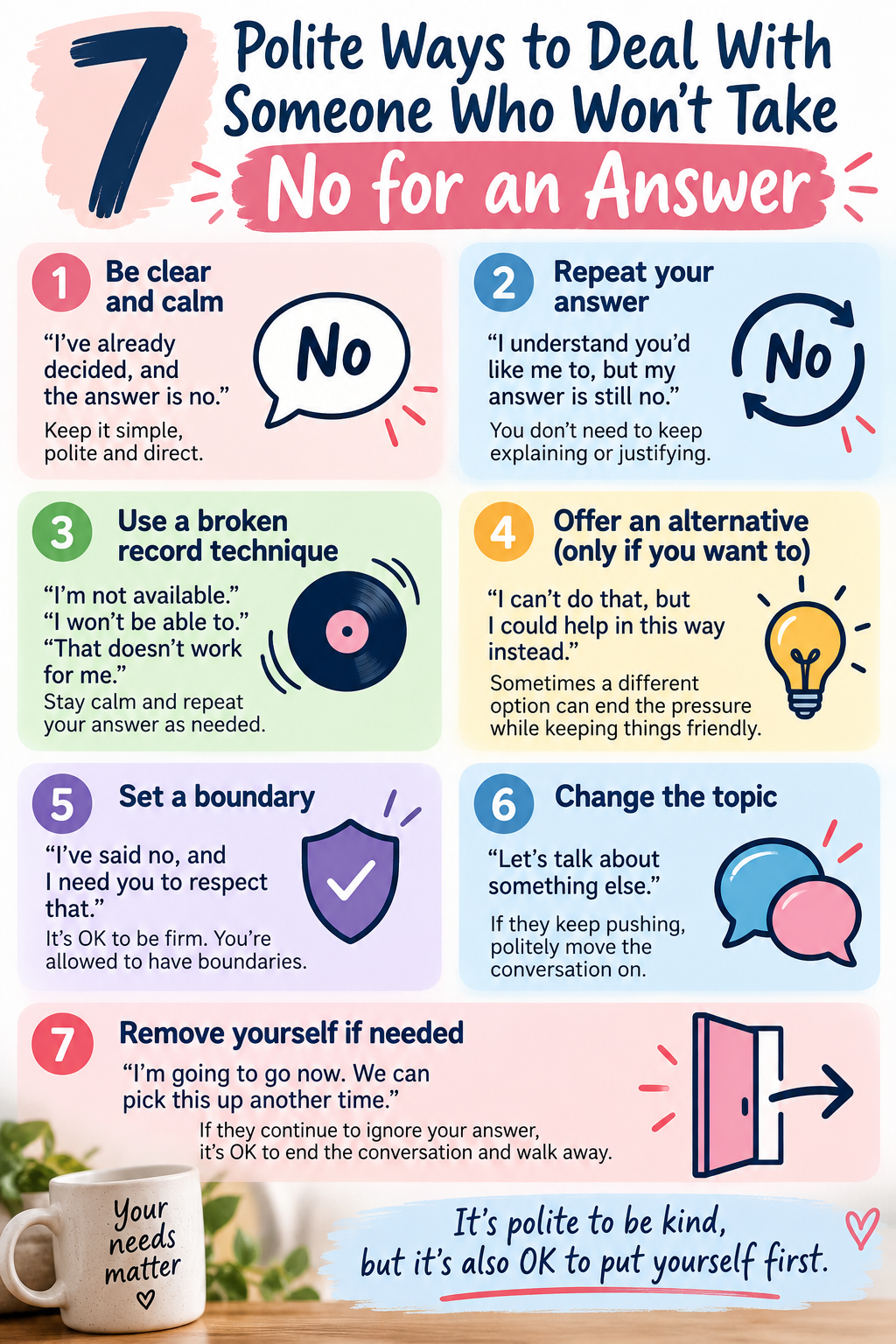
7 Polite Ways to Deal With Someone Who Won’t Take No for an Answer
Have you ever said no to someone, only to find yourself explaining, apologising, and eventually wondering whether it would have been easier just to say yes?
Perhaps a friend keeps asking for a favour. A family member refuses to accept your decision. Or a colleague repeatedly tries to persuade you to take on something you simply don’t have time for.
Dealing with someone who won’t take no for an answer can be exhausting, particularly if you dislike confrontation or worry about upsetting people.
But here’s something worth remembering: you can be polite without changing your answer.
You don’t need to be rude, aggressive or unkind to stand your ground. Often, a few carefully chosen words are all you need.
Here are seven practical ways to handle someone who keeps pushing after you’ve already said no.
One of the most common mistakes when saying no is leaving too much room for negotiation.
You might say:
“I’m not sure I can.”
“I’ll have to think about it.”
“Maybe another time.”
These responses can be perfectly reasonable when you’re genuinely undecided. But if you’ve already made up your mind, they can encourage someone to keep asking.
Instead, try:
“I’ve thought about it, and my answer is no.”
Or:
“Thanks for asking, but I won’t be able to do that.”
You don’t need to sound angry or defensive. A calm, straightforward response is often more effective than a lengthy explanation.
2. Repeat Your Answer Without Adding New Excuses
Some people treat every explanation as an opportunity to negotiate.
If you say you’re too busy, they suggest another day.
If you say you’re tired, they suggest something easier.
If you say you can’t afford it, they suggest borrowing the money.
Before long, you’re defending every detail of your decision.
Instead, repeat your answer without introducing fresh reasons.
For example:
“I understand you’d like me to help, but my answer is still no.”
Or:
“I appreciate that this is important to you, but I can’t commit to it.”
You don’t have to provide a new explanation every time someone asks the same question.
3. Use the Broken Record Technique
The broken record technique is a simple assertiveness strategy: choose a clear statement and repeat it calmly whenever someone tries to change your mind.
Imagine a colleague repeatedly asks you to cover an extra shift.
They say: “Could you just do this one for me?”
You reply: “I’m sorry, I’m not available.”
They say: “But I really need someone!”
You reply: “I understand, but I’m not available.”
They say: “Can’t you rearrange something?”
You reply: “No, I’m not available.”
The key is consistency.
You’re not arguing, becoming emotional or inventing new excuses. You’re simply making it clear that your answer isn’t changing.
This technique can be especially useful when dealing with persistent requests.
4. Offer an Alternative — But Only If You Want To
Sometimes you’d genuinely like to help someone, just not in the way they’re requesting.
In that situation, offering an alternative can preserve goodwill while respecting your limits.
For example:
“I can’t help you move house on Saturday, but I can recommend a local removal company.”
Or:
“I can’t take on the whole project, but I could spend 15 minutes helping you plan it.”
An alternative can turn a difficult conversation into a more constructive one.
However, there’s an important distinction.
Offering an alternative is a choice, not an obligation.
You don’t have to provide a substitute, solve someone else’s problem or make another commitment simply because you’ve said no.
Sometimes, no is enough.
5. Set a Boundary When Someone Keeps Pushing
If you’ve declined politely several times and the other person continues to pressure you, it may be time to address their behaviour directly.
Try:
“I’ve already given you my answer, and I’d appreciate it if you’d respect that.”
Or:
“I understand you’re disappointed, but I’m not going to change my decision.”
You could also say:
“I’m happy to talk about something else, but I’m not discussing this any further.”
These phrases aren’t intended to punish or embarrass anyone.
They’re simply a way of making your limits clear.
A useful boundary tells someone what you will or won’t do, rather than trying to control their response.
For example, “If you keep asking, I’m going to end this conversation” is a boundary you can act on.
6. Change the Subject
Not every disagreement needs a dramatic ending.
Sometimes the easiest way to move forward is to close the discussion and introduce another subject.
For example:
“Anyway, how did your appointment go?”
Or:
“We’ve covered that, so let’s talk about something else.”
Or even:
“I’m not changing my mind. Now, tell me about your weekend!”
Changing the subject works particularly well in everyday situations where you want to maintain a friendly relationship.
Of course, it won’t always work.
If someone keeps returning to the same request, you may need to reinforce your boundary more directly.
7. End the Conversation If Necessary
Occasionally, someone simply refuses to accept your decision.
They might keep asking, try to make you feel guilty or repeatedly ignore your attempts to change the subject.
When that happens, you’re allowed to end the conversation.
Try:
“I’ve explained my decision, and I’m not discussing it any further.”
Or:
“I’m going to go now. We can talk another time.”
Or:
“I don’t want us to argue, so I’m going to leave this conversation here.”
You don’t need to wait until you’re angry or overwhelmed.
Ending a conversation calmly can be more constructive than staying until both people become frustrated.
If someone’s behaviour feels threatening or unsafe, prioritise your safety rather than trying to remain polite.
What If You Feel Guilty After Saying No?
For many people, the hardest part of setting boundaries isn’t the conversation itself.
It’s what happens afterwards.
You might wonder:
Was I too harsh?
Have I upset them?
Should I have helped?
Am I being selfish?
These feelings are particularly common if you’re used to putting other people’s needs ahead of your own.
But feeling guilty doesn’t automatically mean you’ve done something wrong.
You can care about someone and still decline their request.
You can understand their disappointment without taking responsibility for fixing it.
And you can be a generous, thoughtful person without being available for everything.
A useful question to ask yourself is:
“If someone I cared about made the same decision, would I think they were being unreasonable?”
Often, we give other people far more permission to set boundaries than we give ourselves.
Need Help Finding the Right Words?
Knowing that you’re allowed to say no is one thing. Finding the right words in an awkward conversation is another.
That’s why having a few prepared responses can make such a difference.
My Difficult Conversation Survival Kit: 25 Scripts for Boundary-Setting includes ready-to-use phrases for uncomfortable situations, along with practical tools to help you prepare for conversations and communicate your limits more confidently.
If you sometimes struggle to know what to say, it could be a useful resource.
 One of the most common mistakes when saying no is leaving too much room for negotiation.